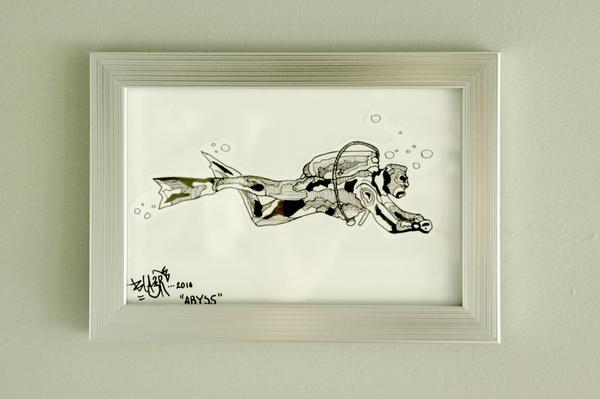
ABYSS
At a certain point in 2018, I was filtering almost everything through a transformed way of seeing. My perception had shifted, and whatever entered my eyes seemed to pass through the same inner lens and re-emerge in my MK23language. Abyss was born in that state. The image of the scuba diver became, for me, much more than a figure underwater. It became a portrait of descent: into depth, into pressure, into silence, and into those parts of the self that only reveal themselves far below the surface.
This connection is also personal. I hold several scuba diving certifications, even though they are no longer updated. At a certain point, when it came to night diving, I completely freaked out. That threshold marked something for me. More than almost anything else, I have always felt that the sea contains one of the purest forms of fear and danger. Its beauty is inseparable from its threat. It is vast, indifferent, and full of life, but also full of darkness, pressure, and the constant reminder that the human body does not belong there. That is part of what gives this work its emotional charge: the diver is not only a symbol, but also a figure tied to a real and personal confrontation with fear.
The sea in this work is not only water. It is also the unconscious. In that sense, the diver moves like a Freudian figure, descending into the submerged territory of instinct, memory, fear, desire, and everything the conscious mind tries to keep in order. The deeper he goes, the less he belongs to daylight logic. He enters a place where forms begin to bend, where thought becomes symbolic, and where reality is no longer stable but fluid, heavy, and psychological.
That is why the title Abyss matters so much. In Nietzsche, the abyss is confrontation: the danger of staring so long into darkness that it begins to return the gaze. In Wilde, the abyss becomes something more intimate and wounded, a descent into suffering, depth, and revelation. Between those two poles, the diver becomes both explorer and exposed being, both seeker and prey. He does not simply observe the abyss. He enters into a relationship with it.
There is also something poetic and brutal in the figure itself. A diver goes down carrying oxygen, technique, and light, but none of those things make him master of what lies below. He is only a temporary visitor in a kingdom that does not need him. The abyss remains older, larger, and more patient than any human body. In that way, the piece speaks about the fragility of consciousness itself: how we descend thinking we are exploring something external, while in truth we may be approaching the most hidden and dangerous parts of ourselves.
So Abyss became my way of turning a diver into a psychological and poetic symbol. It is about altered perception, about the beauty and terror of depth, and about the moment when curiosity becomes exposure. It asks whether the one who descends is searching for truth, escaping reality, or simply discovering that the darkest places are not always outside us, but already waiting within.