tsbreH
The series began in 2021, when I found on the street four beautiful frames in perfect condition, each carrying one of the Chinese Hanzi or Japanese Kanji for the four seasons: Spring 春, Summer 夏, Autumn 秋, Winter 冬. At first, I was struck more by the beauty of the language than by the symbols themselves, and I thought I could simply reuse the frames for some of my originals. But once I flipped the paper, the whole thing changed. That was the spark: everything became the opposite. I started working through reversal, using colours inspired by the opposite season, retracing the symbols as they appeared mirrored, spelling the names of the seasons backwards, and building new compositions around older works. In this way, the frames stopped being found objects and became part of a system of transformation. Inside them I placed four older original works: one from 2017, two from 2018, and one from 2019.
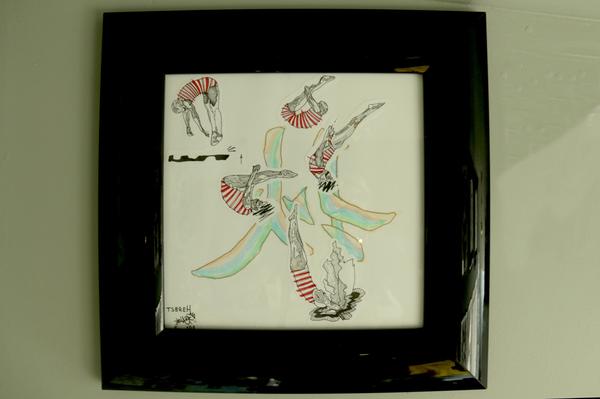
This artwork is called tsbreH, the mirrored and reversed form of Herbst, the German word for autumn.
Inside this piece we find Diver_se #3, created one year after Diver_se 1 and 2. This time, instead of focusing on a single suspended diver, I drew the whole action through four figures: one about to jump, two moving freely through the air, and one piercing the water, with a splash marking the moment of impact. What interested me here was no longer only the threshold, but the full sequence of descent, as if a single body had been unfolded through time and space.
That shift changes everything. In the earlier diver pieces, the tension lived in hesitation, in the instant before the unknown. Here, the hesitation is broken apart into phases. The first figure still belongs to decision, the last one already belongs to consequence, and the two in the middle exist in that strange suspended freedom where the body is no longer held by the ground and not yet claimed by the water. The composition becomes a study of passage, not as a fixed moment, but as a progression.
There is also a deeper metaphor running through the whole piece: the fire of adrenaline and curiosity inside the diver moves through the four elements. It begins on earth, where the body is still grounded and preparing to leave. It then passes through air, where movement becomes freedom, tension, and flight. Finally, it enters water, where the dive is completed and the body is absorbed into another state. The splash becomes the visible mark of that crossing. So the diver is not only moving through space, but through elemental transformation: from ground, to flight, to immersion, driven all the way by that inner fire.
Because it passes through MK23, the scene is not meant to be realistic in a literal sense. It is more like a stretched image of movement, instinct, and impact. The diver is multiplied, almost like memory or perception trying to hold onto each fragment of the act. In that sense, the piece becomes about those moments in life when thought has already ended and action has taken over. Once the jump begins, there is no returning to the edge. The body writes its own sentence through space.
Placed inside tsbreH, this image gains another layer. Autumn is already the season of transition, release, and falling into another cycle. That is why this diver composition belongs so naturally inside it. The four figures echo the logic of autumn itself: preparation, detachment, descent, and arrival. What falls is not lost, but transformed. So tsbreH becomes a work about movement, change, and the beauty of passing from one state into another.